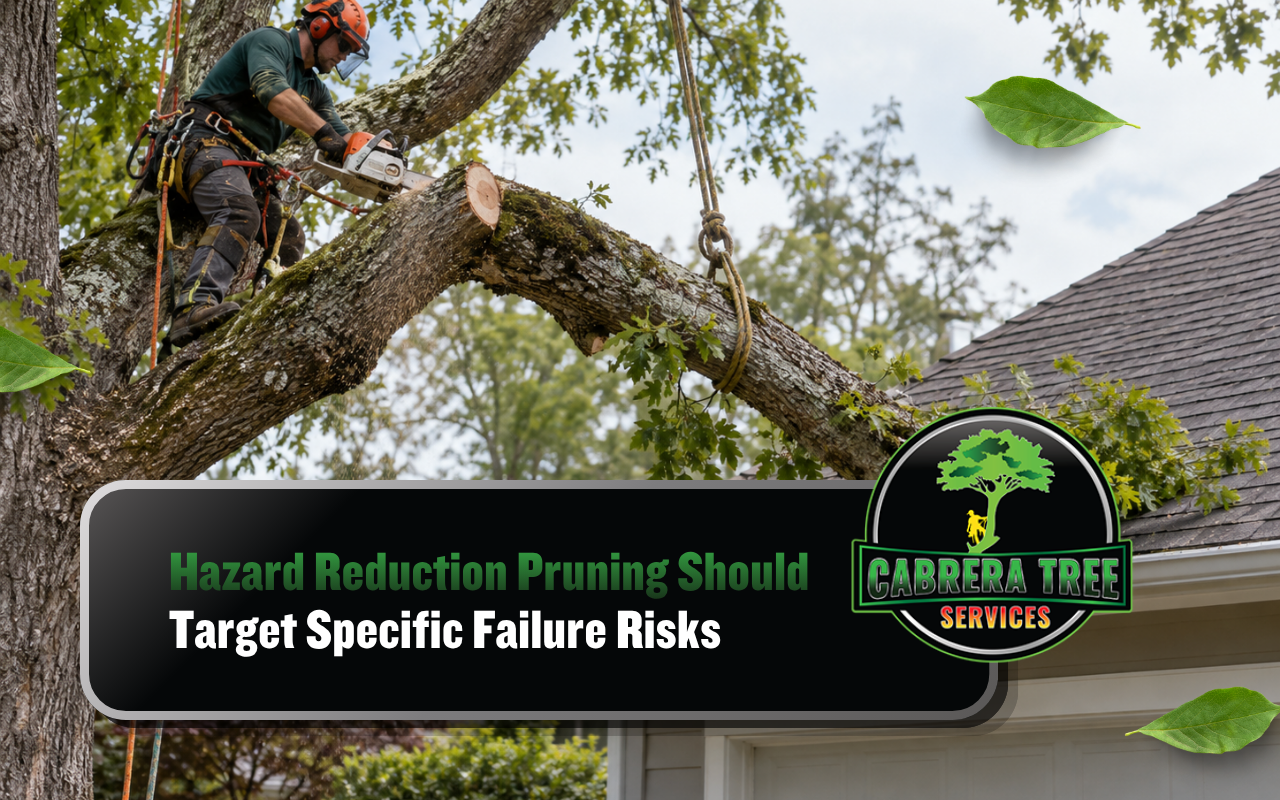
Not every large branch is dangerous, and not every weak branch needs the same response. Effective hazard reduction pruning starts by identifying decay, cracks, deadwood, poor attachments, and what could be hit if a limb fails. explore our tree services or request your safety estimate when branch movement, storm damage, or visible defects create concern.
Risk Reduction Pruning Begins With The Target Below
A weak limb over an unused corner of a property is different from the same limb over a driveway, roof, sidewalk, or entrance. Risk depends on both branch condition and what is exposed beneath it.
Residential and commercial properties often have different target zones, traffic levels, and clearance requirements.
Remove Dangerous Limbs Only After Identifying Their Defects
Deadwood, cracks, cavities, included bark, storm splits, and heavy end weight can all increase concern. The defect should be understood before the cut is selected so healthy supporting structure is not removed without reason.
Safety Pruning Service In Madison Should Prioritize High-Risk Areas
review our tree services or schedule your safety estimate when branches hang above occupied areas or show fresh damage. The highest-risk targets should be addressed before routine cosmetic trimming.
For local pruning information, visit our explore Madison pruning services page.
Diagnostic Tip Compare Similar Limbs Across The Canopy
If one branch has unusual cracking, bark separation, or dieback compared with neighboring limbs, that difference can help identify a localized structural problem. Comparing similar branches is often more useful than judging one defect in isolation.
These Branch Conditions Deserve A Closer Safety Review
- Fresh cracks near major unions
- Dead limbs over active areas
- Storm-broken branches still attached
- Heavy limbs with weak attachments
Pruning And Removal Should Not Be Treated Identically
Sometimes the risk is isolated to one or two limbs. Other times trunk decay, root failure, or widespread structural weakness makes branch pruning an incomplete solution.
For local removal options, visit our explore Madison removal services page.
Licensed Tree Work Matters Around High-Risk Branches Most
Licensed service matters when heavy limbs are positioned over homes, vehicles, utilities, or other valuable property. Controlled cutting and lowering can reduce avoidable impact during the work itself.
Use This Risk Order Before Choosing Branch Removal
- Identify the structural defect
- Identify the target below
- Estimate likelihood of failure
- Choose the minimum effective cut
- Recheck remaining canopy balance
Emergency Response Matters When A Limb Is Already Failing
A hanging or partially detached limb can become unpredictable. People should stay clear of the area and avoid pulling or cutting from below.
24/7 emergency tree services are available when branch failure creates an immediate property or access hazard.
Experience Helps Distinguish Risk Reduction From Over-Pruning Decisions
Our team at Cabrera Professional Tree Service LLC focuses on the specific defect and target rather than removing excessive canopy to make the tree look smaller.
Risk Changes When Branches Hang Above Frequent Activity
A branch above an unused landscape bed does not create the same exposure as one above a front entrance, parking space, playground, or loading area. The amount of activity beneath a branch should influence how quickly a defect is addressed.
This is why pruning recommendations should consider property use rather than judging the branch only by size or appearance.
Previous Storm Damage Can Hide Weakness Inside Branch Unions
A limb may remain attached after a storm but still contain internal cracking or torn fibers near the union. New sagging, bark separation, or a changed branch angle can be clues that the attachment was damaged even when the branch did not fall.
Those changes deserve closer review before the next wind event adds more load to the same area.
Final Canopy Balance Should Be Checked After Hazard Cuts
Removing a heavy hazardous limb can change wind exposure and weight distribution across the remaining canopy. The finished tree should be reviewed for new imbalance rather than assuming the work is complete as soon as the risky branch is gone.
At Cabrera Professional Tree Service LLC, we look at the remaining structure so one risk-reduction cut does not create an obvious new problem elsewhere.
Branch Risk Should Be Rechecked After Major Weather Events
A pruning decision that made sense before a storm may need to be revisited afterward. Wind can twist attachments, open cracks, or leave partially broken limbs that were not present during the earlier inspection.
Homeowners should look from a safe distance for new hanging branches, fresh bark tears, or sudden changes in branch angle. A post-storm review is especially important around entrances, parking areas, and other places where people spend time beneath the canopy.
Property Use Can Change Which Hazards Come First
A branch over a rarely used corner may be monitored differently from one above a school entrance, storefront, driveway, or regularly occupied patio. Prioritizing by actual exposure helps focus pruning where it reduces the most meaningful risk first.
Frequently Ask Questions
Does hazard pruning mean removing large branches?
Not always. The objective is to reduce specific risk while preserving healthy structure when possible.
Can dead branches remain in a tree?
Small deadwood in low-risk areas may be less urgent, while large dead limbs over targets deserve faster attention.
When is removal safer than pruning?
Removal may be more appropriate when trunk, root, or widespread structural failure makes branch pruning insufficient.
Should storm-damaged limbs be inspected quickly?
Yes, especially when cracks, hanging branches, or damaged unions appear over occupied areas.
Can pruning eliminate all tree risk?
No. It can reduce identifiable branch hazards, but trees remain living structures exposed to weather and change.
Reduce The Actual Hazard Instead Of Excess Canopy
Good hazard reduction pruning targets specific defects, considers what lies below, and preserves healthy structure whenever practical. explore our tree services or book your safety estimate with Cabrera Professional Tree Service LLC when tree safety decisions need more than a quick visual guess.