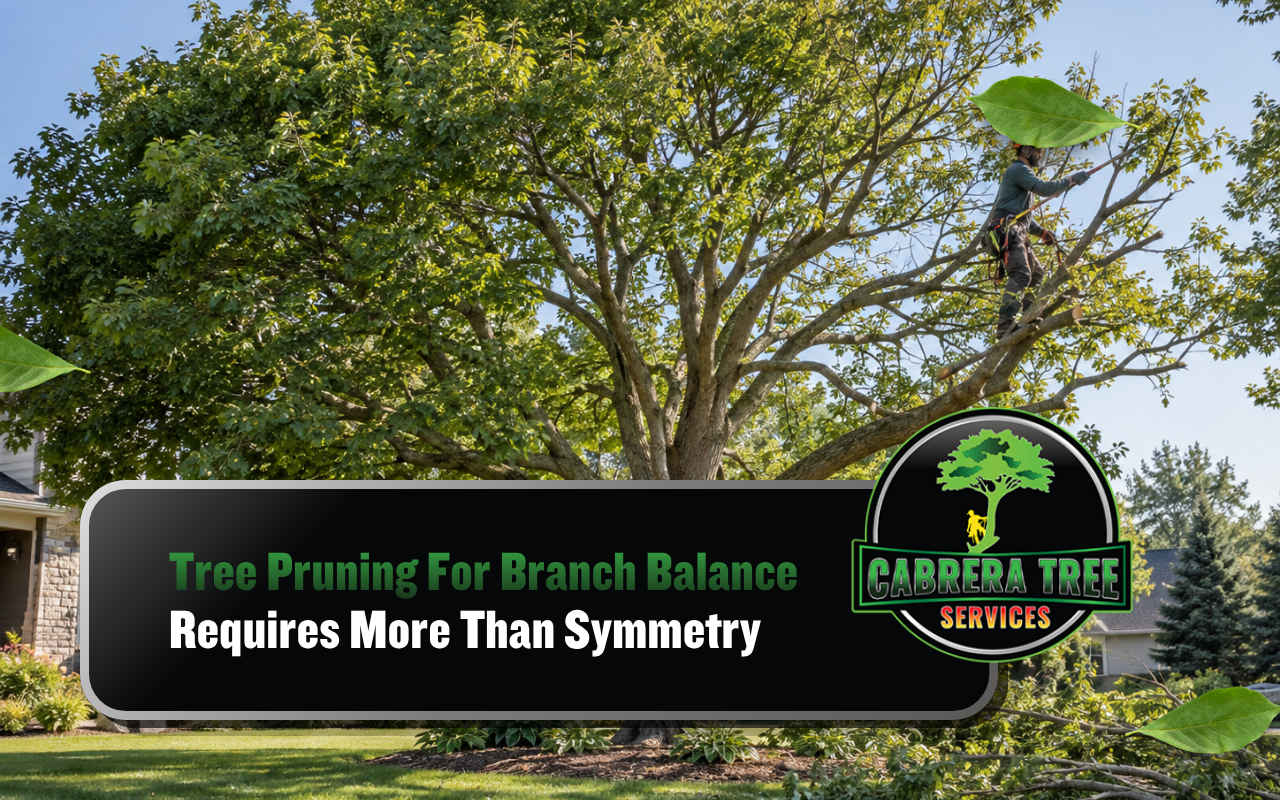
A canopy can look uneven without being unsafe, and it can look symmetrical while carrying poor structural loads. Good tree pruning for branch balance focuses on branch weight, attachment quality, competing stems, and how the canopy responds to wind. explore our tree services or request your pruning estimate when one side feels heavy, low, or structurally different from the rest.
Balanced Canopy Pruning Starts With Branch Weight Distribution
Large limbs extending far from the trunk can create more leverage than shorter branches of similar diameter. Weight distribution pruning should consider length, foliage mass, and attachment rather than cutting simply to make both sides look equal.
Structural Limb Balance In Decatur Depends On Attachments
A long branch with a strong union may be less concerning than a shorter branch with included bark or a crack. Visual balance and structural balance are not always the same thing.
For local service details, visit our explore Decatur pruning services page.
Branch Load Reduction Should Preserve The Remaining Canopy
review our tree services or schedule your pruning estimate when one major limb carries excessive end weight or interferes with nearby structures. The objective is controlled reduction, not stripping an entire side of the tree.
Licensed tree service supports careful work when branch weight must be adjusted around property targets.
Use This Comparison Before Pruning An Uneven Canopy
| Condition | Visual Issue | Structural Concern | Possible Response | What To Avoid |
|---|---|---|---|---|
| One long limb | Canopy looks uneven | High leverage | Selective reduction | Removing whole side |
| Dense interior | Looks heavy | Varies | Targeted thinning | Excessive stripping |
| Weak union | May look normal | Higher concern | Risk-focused pruning | Ignoring attachment |
| Competing stems | Split canopy shape | Possible future weakness | Long-term structural plan | Single aggressive cut |
Weight Distribution Pruning Should Consider Future Regrowth Too
Hard cuts can stimulate fast regrowth that changes branch weight again. Good pruning anticipates how the tree may respond after the current season rather than focusing only on the immediate silhouette.
These Canopy Patterns Deserve Structural Review Before Cutting
- One limb extending far beyond others
- Multiple stems competing from one union
- Heavy branch ends over structures
- Repeated rubbing between large limbs
Tree Trimming And Structural Pruning Serve Different Goals
Routine trimming may address clearance or light deadwood, while structural pruning focuses more directly on branch architecture and load distribution.
For related local service, visit our explore Decatur trimming services page.
Residential And Commercial Trees Face Different Load Conflicts
Residential trees may grow over roofs and yards, while commercial trees may interact with parking, signage, and higher pedestrian traffic. Our residential and commercial service experience helps account for those different targets.
Experience Matters When Balance Problems Are Not Obvious
At Cabrera Professional Tree Service LLC, we evaluate branch relationships and canopy weight before deciding which cuts will improve structure without creating new imbalance.
Emergency Services Matter After Sudden Branch Load Changes
Storm breakage can remove one side of a canopy and shift stress to what remains. A tree that was previously balanced may need reevaluation after major limb loss.
24/7 emergency tree services are available when storm damage changes canopy stability quickly.
Branch Diameter Alone Does Not Explain Structural Importance
A smaller interior limb may support canopy spacing or help distribute foliage, while a larger limb may carry excessive leverage far from the trunk. Pruning decisions should consider function within the canopy rather than ranking branches only by diameter.
This helps preserve useful structure and avoids creating a hollow-looking canopy with most growth concentrated at the ends.
These Balance Mistakes Can Create New Structural Problems
- Removing too much from one canopy side
- Stripping interior branches without purpose
- Leaving heavy end weight after thinning
- Ignoring weak unions that still carry load
Long-Term Balance May Require More Than One Pruning Cycle
Some structural problems are better corrected gradually. Trying to reshape a mature tree in one visit can remove too much live canopy and encourage vigorous regrowth that quickly recreates weight problems.
A staged approach can reduce leverage over time while allowing the tree to maintain enough foliage between pruning cycles.
Property Targets Should Influence Which Limbs Get Priority
When several limbs contribute to imbalance, branches over roofs, parking areas, walkways, or neighboring structures may deserve attention before equally heavy limbs over open ground.
Our team at Cabrera Professional Tree Service LLC combines branch structure with target exposure so the pruning plan addresses both balance and practical property risk.
Branch Balance Should Be Judged From Several Viewing Angles
A canopy can look balanced from the street while appearing heavily loaded from the side or from beneath. Reviewing the tree from several directions helps reveal long limbs, competing stems, and weight concentrations that one viewpoint can hide.
This broader view is especially useful on mature trees where nearby buildings, neighboring canopies, or slopes can distort how branch distribution appears from a single location.
Frequently Ask Questions
Should both sides of a tree look equal?
No. Structural balance depends on branch weight and attachment, not perfect visual symmetry.
Can reducing one branch improve balance?
Yes, when that branch carries excessive leverage or conflicts with surrounding property.
Does thinning always reduce branch load?
Not necessarily. Poorly placed thinning cuts can remove useful interior structure without addressing the main load.
Can storms change canopy balance?
Yes. Losing one major limb can shift wind exposure and weight distribution across the remaining canopy.
Should heavy branches always be removed?
No. Selective reduction may sometimes manage weight while preserving valuable structure.
Prune For Structural Balance Instead Of Visual Symmetry
Effective tree pruning for branch balance considers leverage, attachment, regrowth, and the relationship between major limbs. explore our tree services or book your pruning estimate with Cabrera Professional Tree Service LLC when an uneven canopy needs a structural answer rather than a cosmetic one.